A mineral that may behave differently inside super-Earths
Scientists have found that ferropericlase, an iron-bearing mineral relevant to the deep interiors of rocky planets, can undergo chemical segregation under extreme compression. The international study, led by researchers at Yanshan University, China, was published in Nature Communications on 31 October 2026 (DOI 10.1038/s41467-026-79163-8). Its significance lies in a laboratory result that could refine models of massive rocky planets—not in a direct measurement of any exoplanet's mantle.
“Super-Earth” is a size-and-mass category for planets more massive than Earth. It does not imply an Earth-like atmosphere or habitability. Conditions deep inside these worlds are difficult to investigate and must largely be inferred from experiments and physical models.
Extreme pressure in the laboratory
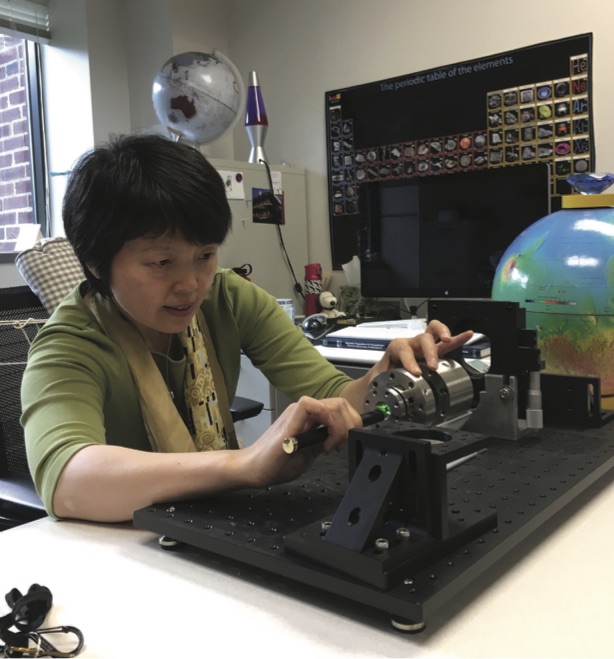
The researchers used laser-heated diamond-anvil cells to compress samples to around 200 gigapascals and reached temperatures as high as 3,300 kelvin. They combined X-ray diffraction measurements, chemical examination of recovered material and first-principles calculations to identify what happened to the mineral.
At the relevant conditions, ferropericlase—a magnesium- and iron-bearing oxide—separated into iron-rich and iron-poor domains. This behaviour complicates simple interior models that treat the material as a comparatively uniform component of the mantle.
The finding is a laboratory observation of compressed material. No telescope or spacecraft has directly measured an equivalent chemical transition in an extrasolar planet.
Why deep-mantle viscosity matters
The authors integrated the experimental findings with theoretical models of planetary interiors. They propose that on rocky planets above approximately 1.5 Earth masses, segregation could favour an iron-oxide-enriched layer with unusually low viscosity deep in the mantle.
Viscosity describes resistance to slow deformation and flow. In a planetary interior, the viscosity structure can affect convection, thermal evolution and how mechanically coupled the mantle is to the core. The proposed layer would therefore be relevant to models of how massive rocky planets evolve over billions of years.
A critical distinction must be maintained: the mineral's segregation was observed under laboratory conditions; the low-viscosity layer is a model-based possibility, not a confirmed feature of any observed super-Earth.
What the experiment does not establish
Actual exoplanets differ in chemical composition, temperature, age and interior pressure. For many of them astronomers know only approximate mass and radius, not the precise makeup of their deep mantles. The suggested threshold near 1.5 Earth masses is contingent on the model and should not be interpreted as a universal boundary at which every planet changes in the same way.
The paper does not announce the discovery of a planet, demonstrate a planetary magnetic-field outcome, or provide evidence of alien life. It offers new constraints on the high-pressure physics of materials that may exist in rocky worlds.
The next tests
Further experiments over broader compositions and pressure-temperature ranges will be needed to determine how widespread the process is. Researchers will also have to test how chemical segregation interacts with other mantle minerals over planetary timescales. Such work can improve the physical interpretation of future observations without claiming to see inside worlds that remain beyond direct sampling.
Primary source: Lv, C., Liu, J., Li, M. et al., Ferropericlase breakdown drives mantle weakening in super-Earths, Nature Communications, 31 October 2026, DOI https://doi.org/10.1038/s41467-026-79163-8 .
Read more
Scientists design surfaces with custom friction laws using numerical optimisation
French researchers report in Nature Physics a numerical method for designing surface textures with prescribed dry-friction laws. Selected designs were experimentally validated, but industrial readiness remains unproven.
Uranium ditelluride reveals coexisting superconducting states—and a missing phase boundary
Cornell-led researchers used ultrasound to uncover a hidden phase transition in UTe₂. Nature Physics results support multicomponent superconductivity—but do not prove a topological state.

Molecular twists may strengthen a biological magnetic compass, new cryptochrome study finds
Researchers in Japan and Germany found evidence linking amino-acid motion inside cryptochrome to quantum-spin effects. A stronger magnetic directional response is predicted by a model, not yet demonstrated in live birds.
Science study finds a chiral signature in MnTe, strengthening the case for altermagnetism
SLAC and ESRF scientists measured different responses to left- and right-circularly polarized X-rays in manganese telluride. The result provides further evidence for altermagnetism, not a working new chip.

Nature Physics study images non-equilibrium Thomson cooling in hot electrons
Scanning-probe measurements distinguish electron and lattice temperatures in HgTe and HgCdTe nanostructures, revealing unexpectedly strong Thomson effects.
Physicists inject spin current from an altermagnet with no net magnetisation
A Nature study demonstrates spin-current injection from Mn₅Si₃ despite zero net magnetisation. The finding is experimental, not a ready-to-use memory technology.